Legal TB-500
Is TB-500 legal? Read the exhibits.
A withdrawn FDA nomination. A sports ban. A small fragment carrying a much larger protein’s reputation. Each has its own entry in the record.

TB-500 legal status
The word “legal” invites a verdict. The paperwork supplies a narrower answer: TB-500 has no FDA-approved medical use, and the question of routine compounding access remains unresolved in the records discussed here. On FDA's page current as of April 22, 2026, the nomination is recorded as withdrawn; TB-500 is no longer in Category 2, while FDA retains its safety concerns. That page gives no date for the removal.
I still need an answer from the agency on the consequential question: what, exactly, may a patient-specific pharmacy prepare? The FDA chronology follows that question through the July 23–24, 2026 advisory meeting. Separately, WADA prohibits TB-500 and thymosin beta-4 in and out of competition. Approval, pharmacy law and sport answer different questions.
The TB-500 peptide
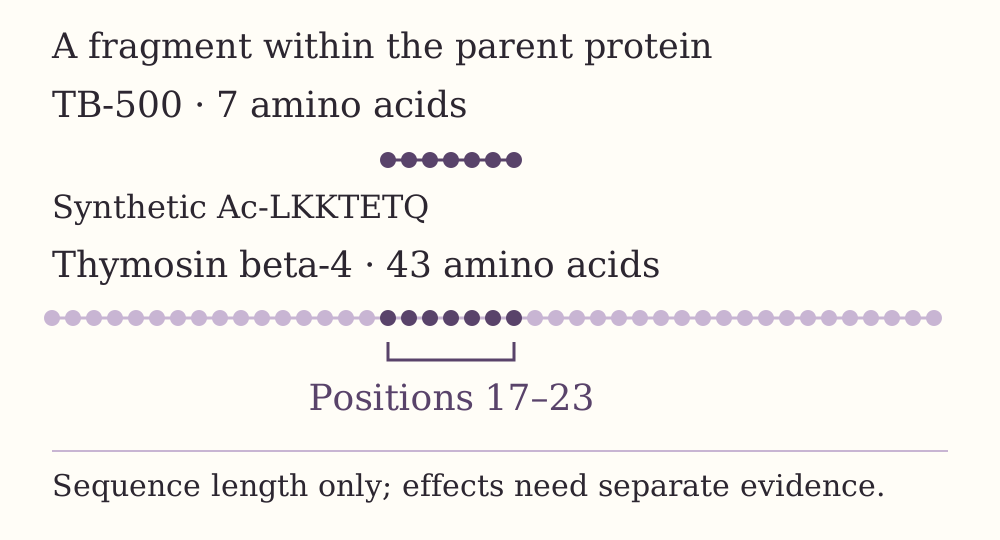
TB-500 is the synthetic Ac-LKKTETQ fragment, a chain of 7 amino acids matching positions 17–23 of thymosin beta-4. There is unusually concrete evidence for that identity: an equine doping-control study identified the fragment and its breakdown products. The laboratory was establishing what it could detect in horse samples.
Full-length thymosin beta-4 contains 43 amino acids. Most of the wound, muscle and heart literature concerns that larger protein, whose actin-binding and tissue-repair biology is reviewed by Goldstein and colleagues. Actin supplies the internal strands cells rearrange as they move. Sharing an actin-binding stretch makes the fragment biologically interesting; how much of the larger protein’s behaviour it retains still needs an answer.
For me, the horse assay is a better opening exhibit than another sweeping recovery claim. It actually identifies TB-500. It establishes detection, with human healing still an open question.
Wound repair and muscle strength
The encouraging wound result deserves its space: in rats, full-length thymosin beta-4 increased re-epithelialization by 42% at 4 days and up to 61% at 7 days versus saline. Re-epithelialization means the new surface covering a wound. The same paper examined contraction, collagen and vessel growth.
Then there are the dystrophin-deficient mice. They developed more regenerating muscle fibres without significant improvements in strength or cardiac function. Fibrosis also remained elevated. I give that failed functional result considerable weight: restoring movement is the ambition behind so many recovery claims, and counting new fibres answers a different question. The research file follows both findings.
The heart case
Full-length thymosin beta-4 improved early cardiac-cell survival and heart function in mice after coronary artery ligation. Other mouse work found heart-surface progenitor cells mobilising and new blood vessels forming. These are substantial experimental observations.
The disease-model muscle study offers a different cardiac result: systolic function showed no significant improvement. The cardiac file sets that observation beside the positive heart findings. Human work on the TB-500 fragment has yet to establish a benefit. I would reopen this case enthusiastically for a controlled fragment trial measuring function; the existing animal work supplies reasons to investigate, with the clinical answer still outstanding.
Reports, amounts and open questions
The effects file collects the recovery stories and unwanted effects people describe, with the anecdotal nature of those accounts stated plainly. Study amounts and half-life covers the quantities researchers actually tested. The safety questions include cancer concerns, long-term uncertainty and BPC-157.
The reading list holds the studies and public records. A claim can be promising, a result can be disappointing, and a legal question can remain open. There is room in this file for all of them.